

WFPAT1

WFPAT1 Test Protocol
WFPAT1 is a valid job-related physical abilities standard used to determine whether an individual possesses the physical abilities necessary to safely and efficiently complete the critical emergency tasks involved in wildland firefighting in Canada.
An emergency wildland fire fighting task is defined as a task in which the safety of the firefighter, a co-worker, or the public may be compromised by failure to complete or inefficient job performance.
The original Canadian Physical Performance Exchange Standard for Type 1 Wildland Firefighters (WFX-FIT) was implemented by the CIFFC member agencies on April 1, 2012 following an extensive investigation of wildland firefighting involving experienced Type 1 WFF. All important physically demanding tasks encountered on the job by WFF were catalogued and then the physical demands associated with performing each task were measured. The WFPAT1 standard and assessment is an update of the WFX-FIT test to ensure the test reflects current wildland firefighting job demands, aligns with best practices in occupational testing, and meets legal and professional standards for validity, safety, and fairness.
It was confirmed that performing the WFPAT1 test protocol involves the same physical demands as performing the related on-the-job tasks. Standards of acceptability were then established for the WFPAT1, based on the physical demands analysis of wildland firefighting work in Canada as well as bookmarking procedures conducted by Subject Matter Experts (SME)s. This research methodology validated the WFPAT1 to meet the standards of a legitimate Bona Fide Occupational Requirement (BFOR) assessment.
WFPAT1 Test Sequence
There are four (4) components to the WFPAT1: a screening component, a standardized warm-up, and two (2) performance components.
- Pre-Participation Screening
- Standardized Warm-up and Task Floor Orientation
- Treadmill Component
- Task Floor Component
- Kettlebell carry
- Pump carry
- Sled pull
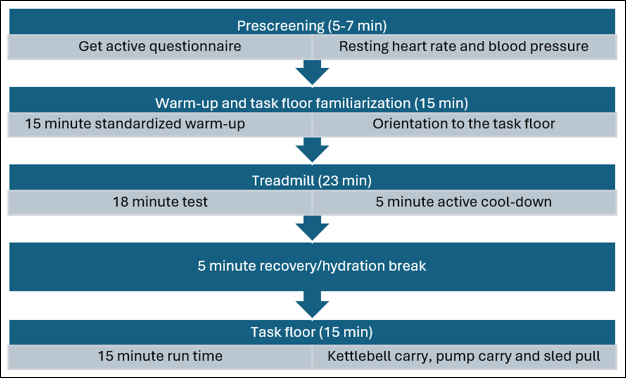
Both performance components of WFPAT1 are timed. The standard for the treadmill component is a completion of 23 minutes of walking at various inclines, going up to a maximum of 15% grade. The standard for the task floor component is working for 15 minutes with a minimum of 12 tasks completed. Type 1 Fire fighters must be able to complete all four components in order to be eligible for national exchange.
Throughout the WFPAT1 test, the candidate wears work-out clothing and running shoes.
Standardized Warm-Up
The standardized warm-up includes the following exercises performed sequentially in the order listed below:
1. Aerobic Activation (3 minutes)
a. Slow jog (3 minutes)
2. Dynamic mobility & activation (7–9 minutes)
a. Upper Body Mobilization (Stationary)
-
- Neck rotations + Chin tucks (Stationary, 5 reps each direction)
- Wrist circles (Stationary, 5 reps per direction)
- Cross-body arm swings
b. Lower Body & Joint Mobility (20m Out & Back)
-
- Walking lunges (Out)
- Walking hamstring stretch (Shoe shiners) (Back)
- Straight-leg kicks (Zombie kicks) - Opposite Hand to Toe (Out)
- Butt kicks (Back)
- High knees (Out)
- Open the gate (Back)
- Close the gate (Out)
- Walk (Back)
c. Core Activation & Stability (Stationary at End of 20m)
-
- Side lunges (Stationary 10 reps each leg)
- Straight leg hamstring stretches 5 second hold (stationary 5 reps)
- Heel Raises (10 reps, slow control)
- Standing knee hugs 5-10 second hold (5 reps each leg)
- Standing quad pull 10 second hold (5 reps each leg)
Treadmill Component
The treadmill component will last 23 minutes and for a ‘pass’ on this section, candidates need to complete the full time. This includes 18 minutes of simulated fireline work followed by a mandatory 5-minute active cool down.
- The candidate will be fitted with a backpack weighing 25 Kg (55 lbs) and get onto the treadmill, standing on the side rails straddling the belt and holding onto the handrails with both hands.
- The candidate will keep their hands on the rails while the appraiser starts the treadmill belt and accelerates it to the test speed of 3 mph. Once the treadmill is up to speed, the candidate will step onto the treadmill belt, remove their hands from the rails, and adopt a normal walking arm-swing motion.
- Note: Except to start and end the test, the candidate’s hands must not be on the rails as this will invalidate the results by significantly reducing the work demands and correspondingly reducing the oxygen cost and heart rate response. A brief touch of the rails to restabilize during the test is allowed but the candidate cannot keep hold of the rail.
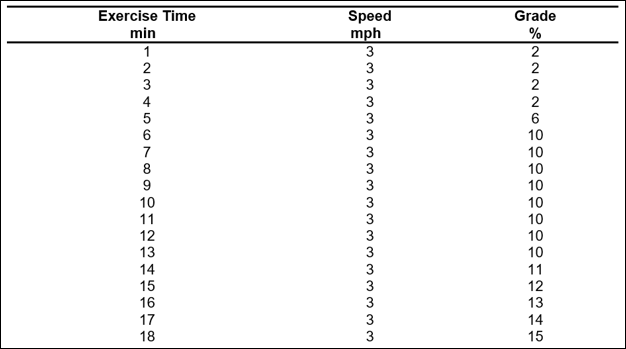
- The treadmill test protocol speeds and grades are shown in the table below. The first 5-minutes of exercise time serve as a progressive intensity warm-up that familiarizes the candidate with the test speed and progressively increases intensity using changes in grade.
- The next 8 minutes are steady state at 10% grade for 8 minutes.
- At 13 minutes, the grade is increased by 1% per minute until 1 minute at 15% grade is completed.
- As soon as the last minute is completed, the candidate will be instructed to grasp the handrails with both hands and straddle the treadmill. The treadmill will be stopped and the elevation will be brought back down to 2% grade. The appraiser will assist the candidate to remove the backpack and instruct them to start a standardized 5-minute cooldown walk at 2mph on the treadmill.
- After the candidate is finished their 5-minute cool down, they will step down from the treadmill and begin their 5 minute allotted rest time before beginning the task floor.
Task Floor Component
The task floor component is made up of three distinct tasks:
- Task 1: Kettlebell carry
- Task 2: Pump carry
- Task 3: Sled pull (wheeled resistance sled)
Each of the 3 tasks that make up the task floor component consists of 2 laps. Each lap involves going 20 metres out, around the cone, and 20 metres back to the starting point for a total distance traveled of 80 metres per task.
The 3 tasks equal 1 cycle. Each cycle is completed when the 3 tasks are completed and the candidate returns to the first task to start the cycle over. Each cycle has a total distance traveled of 240 metres.
The task floor has a 15-minute run time and in order to pass, candidates must complete both the minimum number of 12 tasks (4 cycles) AND continue to work for 15 minutes. The candidate can stop to tie shoes, readjust grip on the equipment or have a drink of water during the test but the timer keeps running. A minimum of 4 cycles (12 tasks) are required within the 15 minutes for a total distance traveled of 960 meters.
Refer to the diagram below for more information on the layout of the task floor.
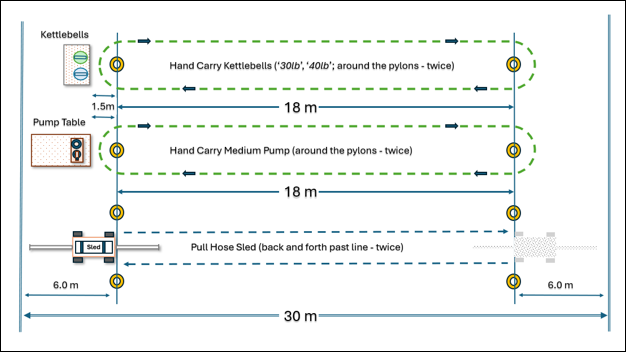
- To begin the test, the candidate picks up the two kettlebells and carries them out and back 2x on the 20 m course, going around the pylons at each end. They are allowed to put them down or switch kettlebells between hands if needed. Once the candidate completes the 80 m of kettlebell carry, they put the kettlebells down on the mat and proceed to the pump carry.
- The pump is located on a table. The candidate picks up and carries the pump out and back twice on the 20m course, going around the pylons at each end. They are allowed to put the pump down on the table or floor if needed to readjust their grip. After completing the 80m of the pump carry, the candidate then puts the pump back on the table and proceeds to the sled pull.
- Using the hose attached to front end of the sled, the candidate pulls the sled down the 20m course until the appraiser tells them ‘stop’ or ‘okay’, indicating that the rear wheels of the sled have passed the pylons. They then lay down the hose and proceed to the other end of the sled and pick up the other hose to pull the sled back to the starting position. After completing the 80m of the sled pull (2x out and back), the candidate then puts down the hose end and returns to the kettlebell carry to begin the next cycle.
- This sequence remains consistent for all cycles. The candidate will continue to move through the tasks for the entire 15 minute test duration in the order shown above. If the candidate does not complete 15 minutes of work or the minimum number of 12 tasks (4 cycles), it is considered a failure.